

A Human-Rights Crime Scene of Coercive Indoctrination and Child Abuse,
Disguised as Religious Care, Compassion, and Education.
THE ACADEMIC RECORDS
THAT DISAPPEARED
How a Monastery School and Belarusian Education Authorities Turned an Ordinary
Parental Request into a Ten-Week Ordeal of Institutional Obstruction
To Whom it Might Concern,
I asked for academic records report!
Not custody. Not access. Not a judicial determination of a decade marked by conflicting jurisdiction, or of the persistent absence of the rule of law in Belarus. Merely copies of my daughters’ academic records, the kind of documentation that any parent, anywhere, should be able to request and receive without hesitation.
This request arose solely because the abducting mother has, for nearly a decade, refused to provide me with any information whatsoever regarding our two daughters’ education, development, or well-being.
Between April and June 2026, I submitted six formal written requests seeking nothing more than these records. Ten weeks later, I had received no transcripts, no grades, no attendance records, no information regarding curriculum hours, and no legally reasoned decision refusing my request.
What I received instead was a revealing portrait of a system in which institutional silence and the systematic distortion of legal and administrative rules function as instruments of policy, from the school itself, to the district education department, and, thus far, to the Ministry of Education, the very authority entrusted with overseeing and ensuring the legality of both.
This is the documented record of those ten weeks, and of the institution it has put on display.
A Simple Request
Nicolaos Cheropoulos, a Swedish and Greek citizen, holds sole legal custody of his daughters, Anthie’ and Alexandra, under a Swedish court order issued on 10 September 2018 and international law. Both girls are enrolled at Ichvis (formally, Ichthys) Secondary School in Minsk. On 6 April 2026, Cheropoulos wrote to the school administration requesting copies of his daughters’ complete academic records, report cards, grade transcripts, and the formal evaluations the school is required to maintain.
The head of the school administration did not provide them. On 17 April 2026, school director T.V. Antanovich replied with a letter describing the girls’ grade averages, their hobbies, and their participation in a vocal studio and theatre club, a narrative, not a record. Cheropoulos wrote back the same day, pointing out, plainly, that a description of his daughters is not a substitute for the documents he had asked for. He never received a substantive reply since then.
That distinction, a request for official records answered with a narrative rather than the requested documentation, proved to be the first manifestation of a recurring pattern, but by no means the last. Instead of receiving the records to which I was legally entitled, I was presented with a revealing illustration of an institutional culture in which administrative silence and the systematic misrepresentation of legal and procedural requirements operate not as isolated irregularities, but as deliberate instruments of policy and governance.


The Documented Timeline
The chronology below is built entirely from dated, written correspondence. Nothing in it depends on interpretation.
Date Letter Recipient Result 6 Apr 2026 Formal request for full academic records Ichvis School (Director T.V. Antanovich) No acknowledgment 13 Apr 2026 Notice of administrative inaction, requesting supervisory intervention Oktyabrsky District Education Department No response 17 Apr 2026 Reply with a photo, describing a narrative rather than the requested documentation Nic. Cheropoulos School replies (No. 699): narrative description, no records 17 Apr 2026 Reply noting the response did not address the request Ichvis School (Director T.V. Antanovich) No response 1 May 2026 Renewed request, demanding records or a written legal refusal Ichvis School No response 11 May 2026 Formal inquiry citing additional evidence of obstruction Oktyabrsky District Education Department No response 12 Jun 2026 Formal appeal citing the silence below it Ministry of Education of Belarus No response on record 17 Jun 2026 Separate inquiry (“About informing”) Oktyabrsky District Education Department Reply: emails “not registered or reviewed”, see below Six letters. One substantive reply, and that not in the form of an answer, but as a photograph from the school responding to a question no one had asked. Every formal letter sent to an authority with the capacity to compel a response has, to date, remained unanswered on its own terms.
What the Ichvis School Actually Is
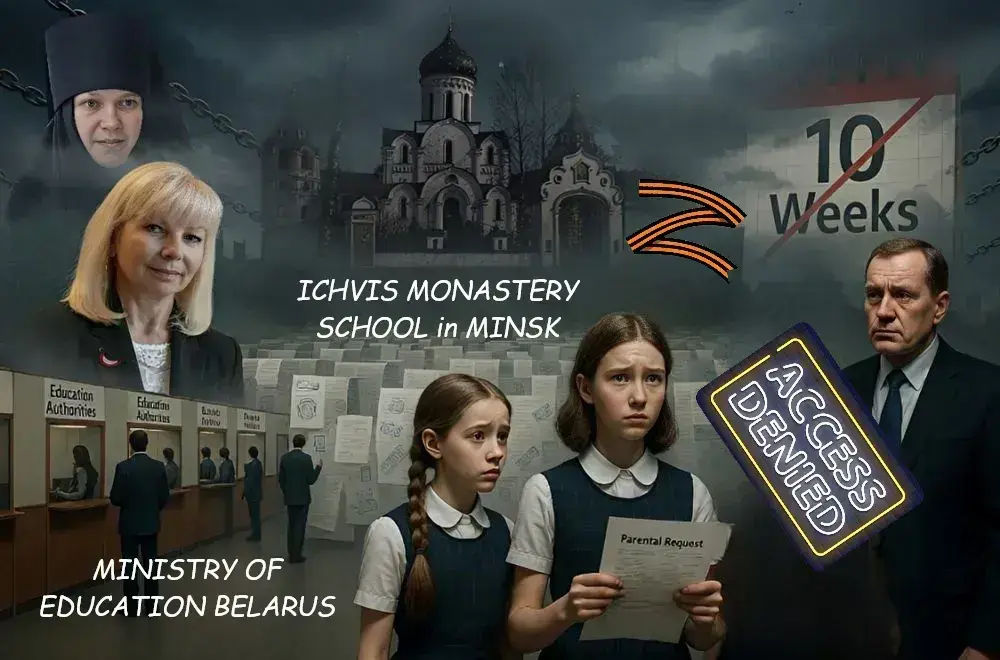
Ichvis School is not administratively separate from St. Elisabeth Convent, the large Russian Orthodox monastery on the outskirts of Minsk led by Archpriest Andrei Lemeshonok. The St. Elisabeth Monastery School Ichvis in Minsk cannot be credibly described as an educational institution. It bears far closer resemblance to a site of systemic institutional malpractice, with serious and lasting implications for children’s education, academic development, and fundamental rights.
After seven years of compulsory English instruction, a significant number of students reportedly remain unable to sustain even rudimentary conversation. This outcome is not a marginal shortcoming; it constitutes prima facie evidence of severe pedagogical failure and raises legitimate concerns of educational misrepresentation, if not outright fraud.
A Human-Rights Crime Scene of Coercive Indoctrination and Child Abuse, Disguised as Religious Care, Compassion, and Education.
A 2024 investigation by the independent outlet Buro Media, based on Belarusian business registry filings, identified the school as part of the convent’s broader holding structure and named its director, the same T.V. Antanovich who signed the 17 April reply, as a nun of the convent serving as the school’s head.
Asked by the same reporters why the school operates at a financial loss, Antanovich did not describe it as an educational service. She called it “an idea project,” undertaken for the sake of the children and the future, language that frames the school’s purpose closer to mission than to education and academic development for the children.
Although the monastery school Ichvis has recently launched a new and more user-friendly website, the controversies surrounding their new website and the institution itself, remain impossible to ignore. Its underlying mission is equally difficult to overlook. To experienced observers, it is evident that the school’s primary purpose is not to provide high-quality education or foster the intellectual development and critical thinking of its students. Rather, it appears to function as an ideological institution dedicated to entrenching the foundations of the so-called “Russian World” doctrine and cultivating a new generation shaped by political indoctrination, reminiscent, in its methods and objectives, of historical youth movements such as the Hitlerjugend.
The Missing Curriculum
The dispute extends beyond the issue of grades. In his correspondence, Cheropoulos repeatedly sought clarification, without success, regarding the number of instructional hours allocated to each subject. This is a matter of particular significance, as the school openly states that its mission is to combine academic education with religious and ideological formation.
A parent in such circumstances is entitled to know how instructional time is distributed: how much is devoted to core academic subjects, how much to religious instruction, and whether the national curriculum is being implemented in its entirety. These are not peripheral questions but fundamental issues of educational transparency and accountability.
Without access to the relevant records, neither Cheropoulos nor any independent party can verify these matters. Indeed, this was the central purpose of the request. The persistent refusal to provide the requested information raises legitimate concerns that the request was never intended to be satisfied. Such non-disclosure inevitably invites the inference that transparency would reveal a significant imbalance in the allocation of instructional time, with core academic subjects receiving less attention than required or expected.
School Ichvis Inside a Controversial Institution
The refusal to disclose records sits inside a larger, independently documented pattern. Buro Media’s investigation described St. Elisabeth Convent as controlling roughly seven affiliated business entities, with former employees describing wages deliberately split so that most pay is recorded as untaxed “charitable donations” rather than declared salary, and convent-run outlets that decline card payment so transactions can be logged as donations instead of sales.
Separately, reporting by Veridica.ro and others has documented Lemeshonok’s open support for Russia’s war against Ukraine, including fundraising that purchased vehicles for the Russian military, and Ichvis pupils performing at a February 2024 event under Russian flags bearing the pro-war “Z” symbol. In late 2025, the Church of Sweden issued a warning to its parishes against hosting exhibitions by the convent’s traveling nuns, pointing to fundraising connected to the war and alleged ties to Russian military intelligence. Comparable exhibitions have already been banned in a number of other European countries.
None of this establishes what specifically motivated the silence Cheropoulos has documented in his own case. It does, however, demonstrate that resistance to external scrutiny is not unique to his request. Rather, it has been independently reported as a recurring feature of the institution’s operational conduct.
The Department That Said the Emails Were Never Read
The most concrete confirmation of how these complaints were actually handled came not from the school, but from the Oktyabrsky District Education Department itself. Replying on 17 June 2026 to a separate inquiry that was filed on 13 Apr 2026.
The department’s reception desk wrote, in full:
“Electronic requests received at the department’s email address or any other email address are not registered or reviewed. In the Republic of Belarus, requests can be submitted through the unified national information system Obrazeniya.bel. Electronic requests received by the Education Department of the Oktyabrsky District Administration of Minsk are reviewed no later than fifteen days, and those requiring additional study and verification, no later than one month.”That sentence retroactively explains the silence following the 13 April and both 11 May letters: by the department’s own account, none of them were ever entered into any reviewable system, because email, to any address, is not treated as a valid channel of submission at all. Cheropoulos’s reply, sent the same morning, was direct: “It’s a very convenient way to cover up the lack of transparency and the rule of law.”
The Portal That Cannot Accept a Foreign Address
That leaves the “unified national information system” as the only channel the department recognizes. The Ministry of Education’s own electronic appeals page requires, as mandatory fields, a “Residence address (place of stay)” selected from a dropdown of exactly six options; Brest region, Vitebsk region, Gomel region, Grodno region, Minsk Region, and Mogilev region, followed by mandatory city, street, and house-number fields, and a phone number verified by SMS. There is no option for a country other than Belarus, and no field for a foreign postal address at all.
Put plainly: the one channel a foreign-national parent can actually use, email, is, by the department’s own written admission, never reviewed. The one channel that is reviewed is built around six Belarusian regions and a Belarusian phone number, with no way for a parent abroad to even begin entering his details. Whether this was designed with a case like his in mind, or simply never had to account for one, the practical result is identical: there is currently no door in this system that both accepts his identity and leads anywhere.
What Can Be Said, and What Cannot
Some distinctions matter enough to state plainly. No court has ruled that a crime has occurred in the handling of this records request. No authority has formally accused the school, the district department, or the Ministry of wrongdoing. Those are not yet established facts, and this account does not claim them as such.
What the documented record does establish, without need for inference, is this: four formal letters to three separate authorities, across two months, produced one reply that did not answer the question asked, one written admission that an entire channel of complaint was never reviewed, and a structural barrier in the only channel that is. Institutions are not generally judged by a single unanswered letter. They are reasonably judged by what happens when the same simple request is repeated, escalated, and documented, and still goes nowhere.
Συμπέρασμα
At the heart of this matter lies a remarkably simple request. It is not a dispute over custody, politics, or theology. It concerns nothing more than access to academic record cards.
If the records can lawfully be released, doing so imposes no meaningful burden. If there is a lawful basis for withholding them, providing that justification in writing likewise requires minimal effort. Yet after ten weeks, six written requests, and engagement with three separate authorities, neither outcome has materialized. Instead, the response has consisted of narratives in place of documents, referral to a complaint mechanism that openly acknowledges it does not review complaints, and direction to an alternative procedure designed for residents of a country in which the requesting parent does not reside.
A right that cannot be exercised through any available administrative channel is not a right in practice, regardless of how clearly it may exist on paper. Until that reality changes, the records remain precisely where they were in April: inaccessible, unexplained, and still being requested.
This raises legitimate and unavoidable questions. Does this failure stem from institutional incompetence? Or is it the product of a system in which qualified professionals are either unwilling or unable to remain, only to be replaced by loyalists whose primary qualification is compliance rather than competence? Alternatively, does the continued refusal to act serve a more troubling purpose: the concealment of misconduct, including the alleged abuses at Ichvis School and breaches of applicable legal obligations?
Does no one understand that the state crisis is being driven by an inability to grasp the gravity of the situation, compounded by incompetent loyalists comfortably seated in their positions, leaving the country exposed to more sanctions and isolation from the rest of the world? Paradoxically, the refusal by Ichvis School and the relevant educational authorities to satisfy this straightforward request has produced an unintended outcome. It has reinforced concerns that the institution prioritizes ideological conditioning over educational transparency, academic accountability, and the core disciplines that should prepare students for their future academic development. Whether justified or not, the persistent absence of transparency inevitably invites such conclusions. These concerns, together with the documented responses received, are brought to the attention of relevant international and European institutions for further consideration.
A second, more tangible consequence also emerged from the request process. Following the inquiries, the school’s website was revised and made more accessible to users, including the provision of clearer contact information. While these changes represent an improvement in usability, significant concerns remain regarding the accuracy, completeness, and transparency of the information presented.
Documentary Basis
All correspondence dates, recipients, and quoted content are drawn from Nicolaos Cheropoulos’s own letters (6 April – 17 June 2026), the Minsk City Court’s Response No. 13083 of 8 November 2018, and a dated email from the Oktyabrsky District Education Department (17 June 2026), held as a Gmail screenshot. The description of the Ministry of Education’s electronic appeals form reflects its live fields as accessed in June 2026 at edu.gov.by/en-uk/elektronnye-obrashcheniya.
 EL
EL  EN
EN  RU
RU  UA
UA  SK
SK  IT
IT  SV
SV