


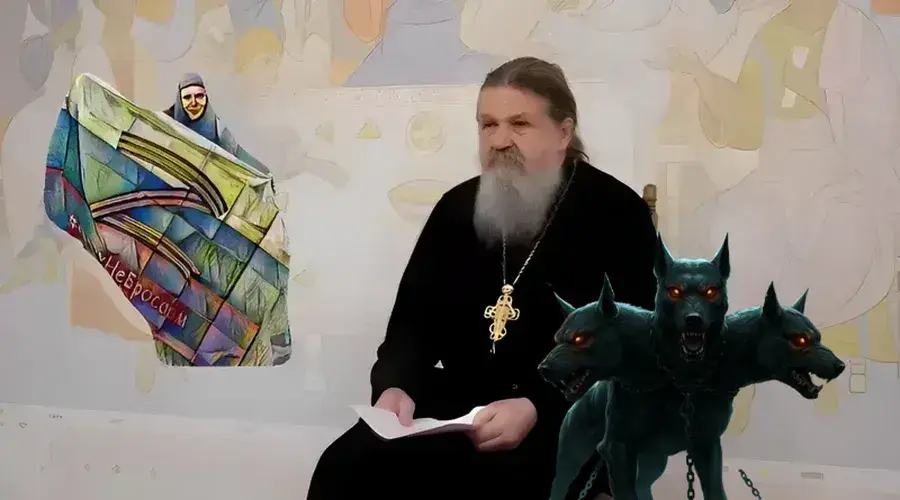
Satan’s Clutches inside the Soul of Andrei Lemeshonok
A Disturbing Case of Spiritual Abuse in Belarus
Lemeshonok’s answer, F*……CK you if parishoners express their opinion
This shocking statement, widely circulated in online recordings, has become a symbol of the increasingly authoritarian rhetoric attributed to Andrei Lemeshonok, a controversial Belarusian cleric connected with St. Elisabeth Convent in Minsk. For many Belarusians, these outbursts represent far more than coarse language: they illustrate a deeper pattern of manipulation, intimidation, and ideological indoctrination within a religious context.
Satan’s Clutches and Lemeshonok presents the case of a manipulative Belarusian cleric whose behavior suggests deep-seated personality disorders, using fear, deception, and propaganda to control and abuse his parishioners. I initially thought I would avoid writing about yet another of the many unhinged figures operating in Belarus. However, that resolve quickly crumbled when I listened to the charlatan and businessman Andrei Lemeshonok and heard the way he speaks to parishioners who dare to hold a worldview different from his own.
Lemeshonok, a self-proclaimed priest, who doesn’t have any relevant theological education, actually, he doesn’t have any education at all, and with a shallow and questionable intellectual level, tells his parishioners to f…..ck you if they express their opinion.
That is the level of Andrei Lemeshonok, with a damaged psyche, who is using outdated propaganda cliches like the riot police “saved Belarus”, “if not Russia (Putin) helped, Belarus would not exist”, “that in Libya under the dictator Khaddaffi, it was almost ideal-the only president for the people” and closing his delirium with, “the parents of children beaten by riot police must themselves repent for raising such children”!
How did this primitive and mentally damaged individual raise his child (there is enough to read about his son’s Neo-Nazi values)? How can this primitive talk about traditional family values when he was not able to maintain his family? The answer to this question is self-evident when looking at the following video clip.
Who Is Andrei Lemeshonok?
Andrei Lemeshonok is frequently described in Belarusian media and opposition circles as a self-proclaimed spiritual authority whose rise to influence has come not through theological scholarship but through charisma, authoritarian messaging, and alignment with pro-Kremlin narratives.
According to numerous public critics:
- he lacks formal theological education,
- his ideological messaging closely parallels state and pro-Russian propaganda,
- and his emotionally aggressive statements toward parishioners raise concerns about psychological harm.
While his supporters portray him as a “strict moral guide”, many others see him as a religious figure who leverages spiritual authority for ideological and financial influence.
The Viral Moment: “F*** You If You Have Your Own Opinion”
For a man occupying a position of spiritual leadership, the tone shocked many Belarusian viewers.
It reveals:
- intolerance of independent thinking,
- a reliance on fear-based control,
- and an authoritarian psychological pattern more reminiscent of political extremism than Christian pastoral care.
Fragment of a sisterly meeting with Andrei Lemeshonok 11/22/2020, Christian Vision
Propaganda Narratives and Political Messaging
Lemeshonok has been repeatedly criticized for promoting ideological talking points closely aligned with authoritarian and pro-Kremlin narratives. Among the statements attributed to him in public speeches or recordings are claims such as:
- Belarus was “saved” by riot police during the 2020 protests.
- Belarus would cease to exist without Russia and Vladimir Putin.
- Muammar Gaddafi’s Libya was “almost ideal,” despite its authoritarian rule.
- Parents of protesters injured by riot police should “repent for raising such children”.
These remarks, while his personal opinions, have been interpreted by analysts as part of a larger propaganda discourse designed to delegitimize dissent.
Such rhetoric mirrors the language used by state authorities to justify violence and suppress civil opposition.
A Controversial Influence on Families and Children
One of the most sensitive concerns expressed by human rights observers involves the impact of Lemeshonok’s teachings on children and vulnerable adults associated with St. Elisabeth Convent.
Critics allege that:
- the convent’s activities increasingly prioritize ideological indoctrination over education,
- young people are encouraged to adopt rigid, state-aligned worldviews,
- and the monastery environment is used as a platform for psychological dependency rather than spiritual care.
Several journalists and analysts argue that the institution operates partially as a commercial enterprise, where loyalty is cultivated to sustain both influence and financial support.
While these claims are debated, they raise serious questions about ethical boundaries, spiritual exploitation, and the responsibilities of religious institutions in authoritarian environments.
“Traditional Values” and Personal Conduct
Opponents often highlight the contrast between Lemeshonok’s advocacy for “traditional family values” and allegations regarding his own family life. Critics argue that his personal history and the publicly reported extremist leanings of his adult children stand in tension with the moral authority he claims to represent.
These critiques, though part of public discourse, ultimately reflect a broader question:
How can a spiritual leader preach moral purity while engaging in rhetoric that humiliates, demeans, and psychologically pressures his own followers?
A Business of Faith or a Faith in Business?
Perhaps the most persistent criticism is that Lemeshonok allegedly uses St. Elisabeth Convent as a commercial platform rather than a religious sanctuary. Over years, the convent has built a vast economic network—bookstores, candle factories, souvenir stands, international sales—that critics claim serve not only charitable aims but also political and personal power structures.
Some analysts argue that the messaging surrounding “Russian World” ideology complements this commercial model, helping secure political protection and donor loyalty.
Greed, Power, and the Metaphor of “Satan’s Clutches”
Many Belarusians who oppose Lemeshonok’s rhetoric use one of his own favorite expressions to describe what they see happening:
“Satan has his clutches deep inside your soul”.
For his critics, the phrase has become symbolic, a description of spiritual authority corrupted by greed, power, and ideological servitude. Instead of guiding people toward emotional or moral healing, Lemeshonok’s approach fosters fear, conformity, and psychological dependency.
Conclusione
The case of Andrei Lemeshonok serves as a stark reminder of how religious authority can be weaponized during political crisis. Whether viewed as a political actor, a self-styled spiritual leader, or merely an aggressive propagandist, his influence raises critical questions about:
- the ethics of spiritual leadership,
- the vulnerability of people seeking faith under authoritarian rule,
- the use of religious institutions as ideological instruments,
- and the responsibility of society to identify and resist psychological manipulation.
As Belarus continues to struggle for democratic reform and human dignity, the behavior of figures like Lemeshonok illustrates the deep connection between authoritarian politics and authoritarian religion.
And for many Belarusians observing his actions, one conclusion seems inescapable:
If there are “Satan’s clutches” at work, they appear not in dissenting parishioners—but in the spiritual corruption of those who claim to lead them.
The primitive and authoritarian Andrei Lemeshonok, with no education and a cruel personality is destroying young children and weak-minded people at the monastery St. Elisabeth in Minsk, which he uses as a pretext to run his business in the name of Christianity.
Andrei Lemeshonok is no more Christian than Stalin or Mao Zedong was. He runs a business in the name of St. Elisabeth Convent to earn money and power, and doesn’t really care if children will have a good education or not. His main goal is to brainwash and indoctrinate children and people in need to create loyal supporters of the Russian World (Putin) and maintain his business enterprise, St. Elisabeth Convent.
Greed and the Syndrome of Depravation have taken over his shallow soul.
Nicolaos Cheropoulos
Father of Anthoula and Alexandra
Captives at St. Elisabeth Convent
 IT
IT  EN
EN  RU
RU  UA
UA  SK
SK  EL
EL  SV
SV