How the Russian Orthodox Church Became A Weapon of Political Warfare
The Unholy Alliance:
How the Russian Orthodox Church Sanctifies a Neo-Phallocratic Authoritarian State.
2026.04.14 Translated into Ukrainian and Russian by Elisabeth Sokolovskaya 2026.04.01 A Comprehensive Article by Leon (Nic. Cheropoulos)
The Article is Devoted to my Beloved Daughters, Anthie and Alexandra
Abstract
Is contemporary Russia merely a rebranded Soviet Union, or does it represent a fundamentally new model of authoritarianism? This question continues to surface in Western political discourse, often framed with a degree of analytical imprecision that obscures more than it reveals. A closer examination demonstrates that Putin’s Russia is not a continuation of Soviet communism, but a transformation of it, one that integrates the coercive infrastructure of the Soviet state with a strategically mobilized religious doctrine.
What has emerged is a hybrid system: a centralized security state reinforced not by ideological atheism, as in the Soviet period, but by a state-aligned theological narrative. The Russian Orthodox Church, far from operating as an independent spiritual institution, functions as a legitimizing arm of political power. In this configuration, religious symbolism, historical revisionism, and moral rhetoric are deployed to consolidate authority, shape national identity, and neutralize dissent. The result is a form of governance that is simultaneously authoritarian and sacralized, an arrangement that redefines the relationship between state, ideology, and legitimacy in the 21st century.
The article “Putin’s Russia” advances a comparative analysis of the Soviet Union and Putin’s Russia, arguing that the latter represents not a regression but an evolution: from secular authoritarianism to a politically instrumentalized theocratic framework. It examines how institutional continuity, particularly within the security apparatus, has been combined with ideological reinvention, producing a system that is both historically rooted and strategically adaptive.
Central Question
How did a post-Soviet state evolve into a theologically legitimized authoritarian system?
Methodological Note
Putin’s Russia analysis employs a comparative historical framework to examine structural continuities and ideological transformations between the Soviet Union and contemporary Russia. It focuses on three primary dimensions: (i) the evolution of state power and coercive institutions, (ii) the functional role of the Russian Orthodox Church within the political system, and (iii) the construction of ideological narratives used to legitimize authority domestically and project influence internationally. By integrating political analysis with elements of political theology, the article seeks to move beyond surface-level comparisons and identify the mechanisms underlying this systemic transformation.
Structure of the Analysis
The Arguments are developed across twelve thematic sections and a reference section:
To understand the present configuration of power in Russia and Belarus, it is necessary to begin not with its current leadership, but with the institutional and ideological legacy from which it emerged.
I. The USSR: Brutal Atheism in the Name of the Collective
The Soviet Union was, above all else, an ideological project. It was atheistic, doctrinaire, and, in its own perverse way, egalitarian. Women worked in factories and commanded military units. The state’s propaganda machine recognized no divine authority higher than the Communist Party. Religion was suppressed, church property was seized, clergy were imprisoned, shot, or sent to labor camps. The Bolshevik revolution explicitly dismantled the symbiosis between the Tsar and the Russian Orthodox Church that had defined Russian political culture for centuries.
The Soviet state murdered people on an industrial scale. It engineered famines, ran the Gulag, exported revolution at gunpoint, and maintained control through a security apparatus, the KGB, that permeated every layer of society. But it did not dress its executioners in cassocks and call them holy. Its violence was, at least, nakedly ideological. The Soviet system claimed to serve History, the proletariat, and the future. It did not claim to serve God.
The gender dynamics of the Soviet state were also, paradoxically, more progressive in formal terms than what Putin’s Russia now promotes. Soviet women were legally equal to men. The state required their labor and ideologically demanded their participation. The patriarchal family structure, while never fully dismantled in practice, was not elevated as a political principle. It was not consecrated from the pulpit. There was no Patriarch of Moscow issuing theological justifications for female subordination to their husbands, because there was no Patriarch of Moscow with any political standing whatsoever.
The Soviet system was brutal in the manner of all totalitarian states. But its brutality was bureaucratic, ideological, and secular. It kept its murderers in uniform, not vestments.
II. Putin’s Russia: A KGB State Dressed in Icons
Vladimir Putin is a product of the KGB. He was trained by it, formed by it, and continues to govern through the institutional culture it created. This is not a metaphor or an insult, it is a documented biographical fact. The KGB did not simply disappear when the Soviet Union collapsed; it rebranded, reconstituted itself, and ultimately recaptured the Russian state through the figure of its own former officer.
What distinguishes Putin’s Russia from the Soviet system is not merely its capitalism, a rapacious, oligarchic capitalism that has nothing to do with market competition and everything to do with criminalized accumulation, but its ideological architecture. Where the Soviets had Marx, Lenin, and the dialectic of history, Putin has icons, incense, and Patriarch Kirill. Where Soviet leaders suppressed the Church to maintain ideological monopoly, Putin has embraced it to achieve the same result through different means.
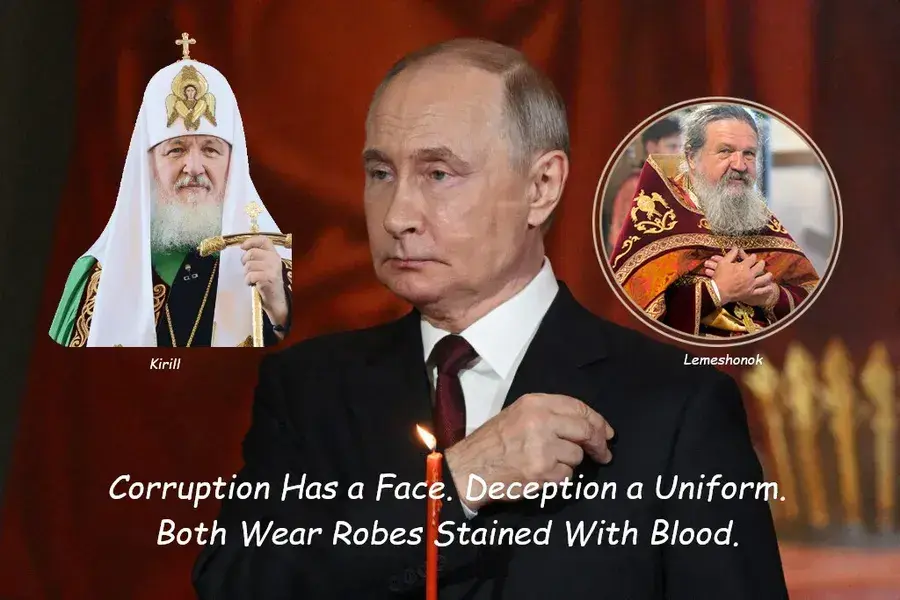
The Russian Orthodox Church, in its current form under Patriarch Kirill, whose secular name is Vladimir Mikhailovich Gundyayev, functions as the ideological department of the Kremlin. This is not an exaggeration. Kirill has publicly declared that Russian soldiers dying in Ukraine are absolved of their sins by their battlefield sacrifice. He has blessed the invasion of a neighboring country. He has framed the war in Ukraine as a metaphysical struggle against Western moral decadence, specifically citing LGBTQ+ rights as a justification for military violence. This is, stripped of its theological veneer, a medieval political theology of violence wielded in service of a 21st-century authoritarian state.
Leon (Nic. Cheropoulos), writing on ActionAgainstChildAbduction.org, has analyzed this dynamic with unusual frankness: the ROC does not merely tolerate the Kremlin, it is structurally fused with it. The Church’s wealth, institutional power, and international presence all depend on its relationship with the Russian state. In exchange, it provides the moral legitimacy that the Kremlin cannot generate through democratic means, because democratic means have been systematically destroyed.
III. The Patriarch’s Gulfstream: Sacred Hypocrisy at Altitude
The moral authority of the Russian Orthodox Church collapses spectacularly under scrutiny. Investigative reporting by Projekt and Meduza, the independent Russian-language media outlets that the Kremlin has designated as “undesirable organizations” precisely because they publish the truth, has documented a portrait of Patriarch Kirill that could not be more distant from the ascetic piety he publicly performs.
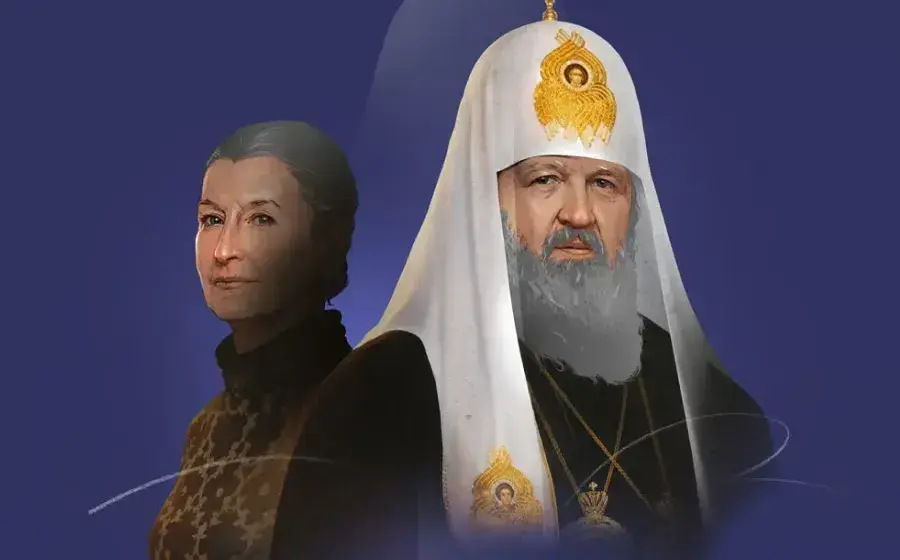
According to these investigations, Patriarch Kirill has maintained a long-term secret relationship with a woman named Lidia Leonova (née Kholodova) for more than five decades. A substantial portfolio of luxury assets, luxury apartments in Saint Petersburg and Moscow, country estates, a fleet of BMWs and Lexus vehicles has been registered in her name through a company called “Vladolid”, a transparent fusion of “Vladimir” and “Lidia”. The Patriarch travels on a Gulfstream G450 business jet valued at approximately $43 million. He was famously photographed wearing a Breguet watch worth $30,000, leading the ROC’s press office to attempt a Photoshop removal, while neglecting to also edit out the watch’s reflection in the polished table beneath it.
As Leon (Nic. Cheropoulos) writes in his January 2026 article «Traditional Values – The Russian Myth», on ActionAgainstChildAbduction.org: the ROC’s moral authority does not merely suffer reputational damage from these revelations, it is structurally fraudulent. An institution that demands sexual restraint, material sacrifice, and obedience to patriarchal family structures while its leader allegedly maintains a secret mistress and a multi-million-dollar asset empire has forfeited any claim to moral legitimacy.
This is not a minor contradiction. It is the defining characteristic of the system. In Putin’s Russia, as in all authoritarian states, moral rules exist for the governed, not the governors. The people are commanded to embody “traditional values”: stable heterosexual marriages, large families, submission to masculine authority, and deference to the Church and the state. The elite, meanwhile, operate under what Cheropoulos calls a “dispensation from virtue.” The same Patriarch who declared that Russian soldiers in Ukraine were fighting to preserve “the soul of humanity” against Western degeneracy has lived, by all investigative accounts, a life that violated almost every canonical obligation he publicly champions.
One might fairly ask, what would Lenin have thought? He would have recognized it immediately. He called religion the opium of the people. Karl Marx’s description, as Cheropoulos points out, has in Putin’s Russia been upgraded from metaphor to user manual.
IV. The Phallocratic State: Masculinity as Political Theology
To call Putin’s Russia phallocratic is not rhetorical excess. It is an analytical description of a system where male dominance is not merely tolerated but institutionalized, sanctified, and enforced through law, religion, and state violence.
The 2022 decriminalization , and subsequent re-decriminalization following public outcry , of domestic violence against spouses and children was not an accident of Russian legislative drafting. It was a statement of political philosophy. The ROC had lobbied for it explicitly, arguing that criminalizing a man who beats his wife interfered with the God-given authority of the husband over the family unit. This is not medieval Europe. This is the 21st century. This is a G20 nation that holds a permanent seat on the UN Security Council.
The “traditional values” framework that Putin and Kirill export internationally , including through ROC parishes abroad in cities like Stockholm and Berlin , is not a cultural preference. It is a political weapon. As Cheropoulos documents extensively on ActionAgainstChildAbduction.org, the ROC’s international network functions as an instrument of Russian soft power, promoting a worldview in which feminine autonomy, LGBTQ+ rights, liberal democracy, and Western institutional frameworks are framed as existential threats to civilization. The Church’s parishes abroad become recruitment centers for this ideology, reaching into diaspora communities in Scandinavia, the Balkans, and Western Europe.
The personal experience documented by Cheropoulos on his platform illustrates the real-world consequences of this ideology with devastating specificity. His two daughters, Anthie and Alexandra, were abducted from Sweden to Belarus in April 2017 by their Belarusian mother, allegedly with the facilitation and encouragement of figures connected to the Russian Orthodox Church in Stockholm. The children were subsequently hidden for 31 days , evidence gathered by Cheropoulos points to their concealment at the St. Elisabeth’s Convent in Minsk, managed by Archpriest Andrei Lemeshonok. They have attended the Convent’s school, Ixhvis, since being brought to Belarus.
Despite Cheropoulos holding sole custody, despite Belarus having signed the Hague Convention on International Child Abduction, and despite years of litigation, the Belarusian legal system , subordinate to the political will of Alexander Lukashenko and, through him, to Moscow, has refused to enforce international law. The children remain in Belarus. Their father remains in Stockholm. The Church remains beyond reproach in the eyes of the Belarusian and Russian states.
This is what phallocratic authoritarianism looks like in practice. It is not abstract political theory. It is children separated from their father. It is a legal system weaponized against the parent who sought to use it. It is a monastery that encouraging abductions and shelters an abductor while presenting itself as a house of God.
V. Children as State Resource: From Soviet Collective to Orthodox Indoctrination
The Soviet Union treated children as a resource of the collective. The state invested, genuinely and massively, in education, childcare, and the production of Soviet citizens. This was instrumentalization, not liberation, but it was at least instrumentalization toward a defined social good: literacy, technical training, ideological formation for the Communist project.
Putin’s Russia, especially since 2022, has demonstrated a far darker conception of children as state property. The mass deportation of Ukrainian children from occupied territories, documented by international investigators and the basis, in part, for the International Criminal Court’s arrest warrant against Vladimir Putin issued in March 2023, represents the weaponization of childhood on a scale not seen in Europe since the Second World War. Children are removed from their homes, placed in Belarus, placed with Russian families, re-registered as Russian citizens, and subjected to ideological re-education. This is not collateral damage of war. It is deliberate policy.
The Russian Orthodox Church has actively furnished theological justification for this policy. Maria Lvova-Belova, Russia’s Commissioner for Children’s Rights, and herself the subject of an International Criminal Court arrest warrant, has openly recast the program as an act of Christian charity, framing the forced transfer of Ukrainian children as a moral rescue from the alleged corruption of a pro-Western order. The Church has raised no objection; rather, Orthodox institutions have, in certain cases, directly participated as receiving entities, thereby embedding themselves within and facilitating the institutional machinery of child removal.
Cheropoulos’s analysis on ActionAgainstChildAbduction.org frames this clearly: the ROC’s role in his own daughters’ abduction is not an isolated incident but a microcosm of the Church’s broader function as an institution that treats children not as autonomous human beings with rights but as subjects of ideological formation, to be cultivated as loyal servants of “The Russian World” , what he calls the “Russkiy Mir” ideology.
The easiest way, as he writes, to produce a new generation of supporters loyal to Putin and Lukashenko is to capture them young, place them in monasteries and church schools, and cut them off from any competing influence, including their own fathers.
VI. The KGB Never Left, It Just Changed Its Collar
Swiss and Russian investigative media have previously reported that Patriarch Kirill (Gundyayev) served as a Soviet intelligence asset in Geneva during the 1970s, officially representing the Moscow Patriarchate at the World Council of Churches. If accurate, this would mean that the head of the Russian Orthodox Church was, in an earlier chapter of his life, an instrument of Soviet state intelligence embedded in an international religious organization , using faith as cover for espionage. It would also mean that Putin and Kirill share not merely an ideological partnership but a professional pedigree.
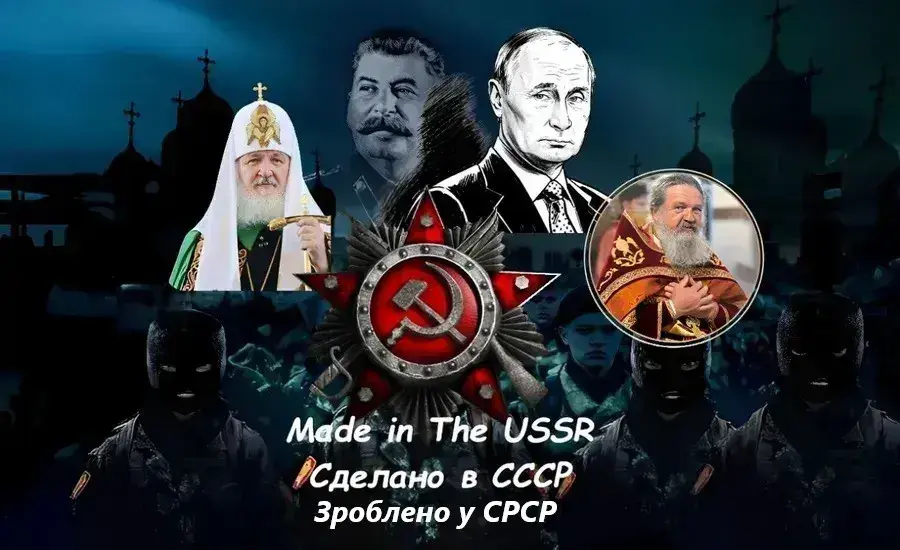
Two former KGB operatives, one governing the state, one governing the Church, collaborating to project Russian power internationally. The Soviet Union never truly ended. It merely traded its red stars for golden crosses.
In the Soviet era, the KGB monitored the Church as a potential source of ideological resistance. In Putin’s era, the Church and the security apparatus work in tandem. The FSB , the KGB’s institutional successor, and the ROC share information, coordinate messaging, and jointly suppress dissent. When the priest Ioann Kurmoyarov spoke out in support of Alexei Navalny, he was denounced by fellow clergy, prosecuted by the state, and ultimately imprisoned. The Church did not defend him. The Church endorsed his persecution.
This is the architecture of the Vladimir Putin system: a security state, a co-opted Church, an atomized civil society, and a judiciary that functions primarily to legitimize predetermined outcomes, all reinforced by a propaganda apparatus that recasts repression as the defense of civilization against barbarism. The Soviet model was, at least, explicit in its authoritarianism. Putin’s version cloaks itself in religious symbolism, wearing a cross stained with blood.
VII. The Belarus Laboratory: Authoritarianism Without Apology
To understand what Putin’s Russia is building toward, look at Belarus. Alexander Lukashenko’s Belarus is the most openly unreconstructed Soviet-style state in Europe, but it too has found theological utility in the ROC. The St. Elisabeth’s Convent in Minsk, headed by Archpriest Andrei Lemeshonok, is a case study in how religious institutions in this part of the world operate as instruments of state power, social control, and ideological reproduction.
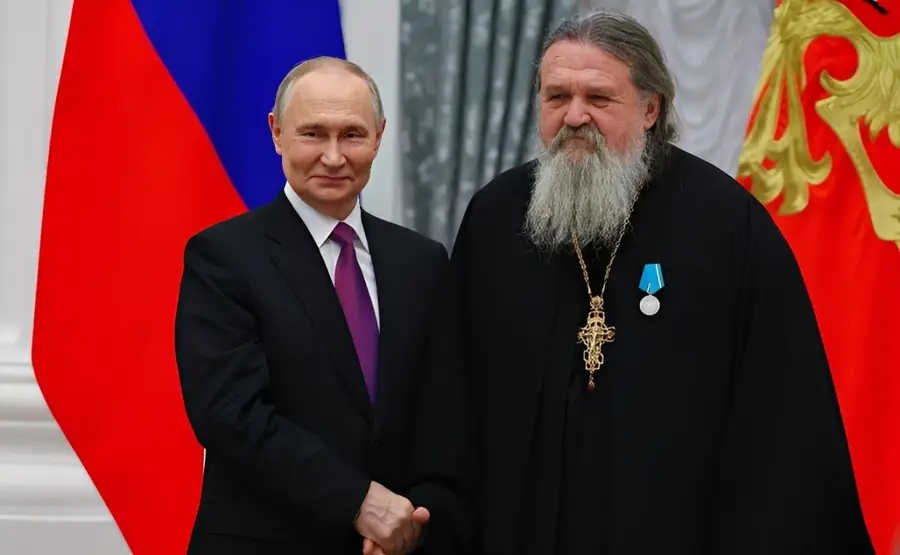
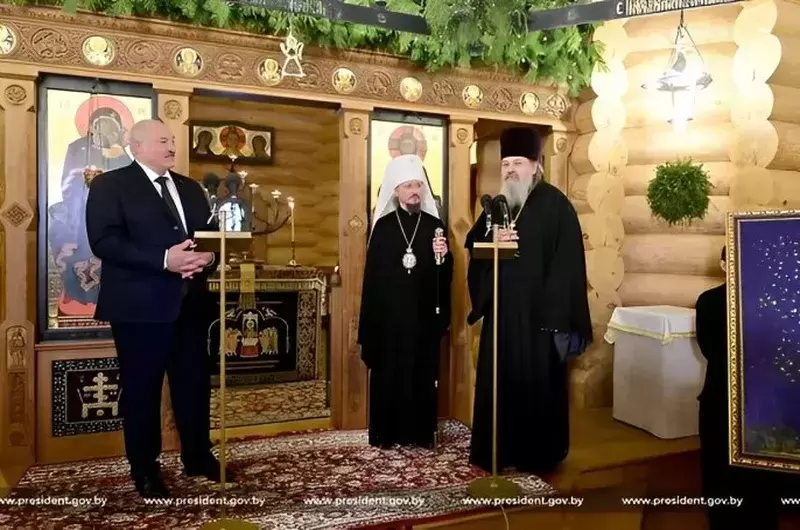
Andrei Lemeshonok was awarded the Pushkin Medal by Vladimir Putin on October 15, 2025, at the Kremlin. The Convent he manages runs a school, a media operation, and a substantial commercial enterprise. It has been implicated in Covid-19 denial during the pandemic, with reports emerging in April 2020 that up to 100 of 130 resident nuns had been infected while Lemeshonok publicly dismissed the disease as a threat. He reportedly described compliance with public health measures as spiritually inappropriate. Nuns were hospitalized. The state authorities of Belarus ultimately ordered the Convent to close temporarily.
The St. Elisabeth Monastery Scandal
And yet Lemeshonok faces no meaningful accountability. In Belarus, as in Russia, religious and political authority are sufficiently intertwined that institutions connected to the Church are effectively immune from the legal consequences that would apply to any secular organization engaged in comparable misconduct. The Belarusian courts have demonstrated, in Cheropoulos’s case and in countless others, that they exist not to dispense justice but to protect the interests of the state and its allies.
The Belarus laboratory teaches us something essential: when the Church and the state merge their interests completely, ordinary citizens, left-behind parents, political protesters, independent journalists, abducted children, become completely unprotected. There is no institution left to appeal to. Law becomes a weapon. Justice becomes a performance. And God, it turns out, is firmly on the side of the government.
VIII. The ‘Traditional Values’ Export: A Political Weapon Aimed at the West
The Kremlin’s “traditional values” ideology is not merely a domestic social policy. It is an internationally deployed political weapon, specifically designed to fragment Western liberal democracies by amplifying their internal cultural conflicts. The ROC’s network of parishes across Western Europe, including the church at Mariatorget in Stockholm documented by Cheropoulos, serves as infrastructure for this project.
Following Russia’s annexation of Crimea in 2014, ROC parishes abroad intensified their promotion of Russian political messaging. This is not speculation. It is the conclusion that Cheropoulos reached after years of direct personal experience with the community at the Russian Orthodox Church in Stockholm, which he documents as a key site in the planning of his daughters’ abduction. The Church is not neutral. It never was. It is an arm of the Russian state operating under diplomatic and religious cover in democratic countries that extend to it freedoms those same countries would never enjoy on Russian territory.
The Soviet Union also operated extensive influence networks in Western Europe, through Communist parties, trade unions, peace movements, and cultural organizations. The methodology is not new. But the KGB never had God on its side. The Kremlin now does, at least officially. This creates a layer of institutional protection that secular Soviet front organizations never enjoyed. A Communist party can be dissolved or discredited. Persecuting a Church, even one that functions as a propaganda vehicle, carries political costs that democratic governments are reluctant to pay.
This is not accidental. It is strategic. The fusion of the KGB’s intelligence culture with the ROC’s institutional immunity has created an asset of extraordinary operational value. Western democracies are designed to protect religious freedom. The Kremlin has weaponized that protection against them.
IX. Silence is Complicity: Democratic States’ Failure to Act
Cheropoulos’s editorial position, stated plainly on ActionAgainstChildAbduction.org, is that silence is not neutrality, inaction is not diplomacy, and legality without justice is complicity. This is not merely a personal credo born of private grief. It is a political observation of considerable importance.
The Swedish Ministry of Foreign Affairs, in Cheropoulos’s account, has consistently refused to categorize the abduction of his daughters as a political abduction, preferring instead to treat it as a civil matter, a private family dispute. This framing is not merely inaccurate. It is, functionally, a political decision to shield a Belarus-connected religious network from scrutiny and to avoid a diplomatic confrontation that Swedish authorities have apparently decided is not worth having.
The Soviet Union at least had the intellectual honesty to acknowledge that it was an adversary of Western liberal democracy. It did not pretend to share the West’s values while undermining them from within. Putin’s Russia, by contrast, has mastered the art of operating inside democratic systems while actively working to destroy them. It uses freedom of religion to protect the Church. It uses freedom of speech to amplify its propaganda. It uses international legal frameworks like the Hague Convention as tools when useful, and ignores them when not, all while Western governments engage in what Cheropoulos calls “quiet diplomacy”, which in practice amounts to state-sanctioned silence in the face of documented abuse.
Democratic governments that tolerate this, that continue to treat the ROC as a legitimate religious institution rather than what the evidence increasingly suggests it is, namely a foreign intelligence-aligned political organization with a religious veneer, are not being diplomatically prudent. They are being naive at best, and complicit at worst.
X. Manufactured Dependence: What the Church Does to Young Females
One of the most insidious and least discussed dimensions of the ROC’s social project is what it does to young girls. Not what it claims to do, which is to nurture, protect, and guide them in accordance with divine law, but what it actually produces: women structurally conditioned to be dependent, compliant, and incapable of functioning as autonomous agents in their own lives.
In the theological framework promoted by the ROC and enforced through the educational institutions it controls, including monastery schools like the Ichvis school at St. Elisabeth’s Convent in Minsk, where Cheropoulos’s daughters have been enrolled, girls are taught not to think critically but to defer. Deference to God, to the priest, to the father, to the husband. The catechism of submission is comprehensive: the woman’s role is defined by her service to masculine authority, her worth measured by her fidelity to the family unit as the ROC defines it, her intellectual curiosity treated not as a gift to be cultivated but as a potential source of spiritual danger.
In this system, children are taught what to think, never how to think. Critical reasoning is not a pedagogical goal; it is a threat. A girl who learns to question the authority of the priest will eventually question the authority of the husband. A girl who learns to evaluate evidence will eventually evaluate the claims of the state. This is precisely why critical minds are considered dangerous in the institutional culture of the ROC in Russia and Belarus. Independent thought is the enemy of all authoritarian systems, but it is particularly incompatible with a system that derives its authority from the claim of divine revelation. You cannot reason your way out of God’s word, and that, in the ROC’s educational model, is the point.
The consequences of this systematic intellectual and emotional stunting are not abstract. They are statistical and personal. Young women who emerge from this environment, having been taught that their value is relational rather than individual, that their purpose is defined by their biology and their service to men, that independence is a form of sin, face a brutally limited set of futures in the societies of Russia and Belarus.
Some marry within the system and replicate it in the next generation. Some find themselves in abusive relationships from which the Church itself, through its institutional hostility to divorce and its lobbying against domestic violence legislation, has methodically removed the exit routes. And a significant number, lacking the professional skills, financial independence, and psychological agency that a genuine education would have provided, end up in the grey economies that border states like Russia and Belarus export with industrious efficiency: sex tourism, trafficking networks, or marriages to foreign nationals arranged not from love but from desperation, a search for basic dignity and economic survival that the societies they were raised in systematically withheld from them.
The phenomenon of women from the former Soviet space marrying Western men to escape poverty and social stagnation is so well-documented as to have become a cultural cliche. What is less often acknowledged is the structural cause: an educational and social system that deliberately produces dependent women and then offers them no viable path forward within its own borders. The ROC does not merely fail these women. It manufactures their vulnerability as a feature, not a defect, of the system it champions.
The cases in which young women end up in prostitution, whether on the streets of Moscow, in the clubs of Minsk, or trafficked to Western European cities , are not aberrations from the ROC’s social project. They are its predictable outcomes. A society that raises girls to be economically and emotionally dependent, that removes legal protections from abuse, that closes off avenues of autonomous professional development, and that simultaneously maintains vast inequalities of wealth, produces a supply of desperate women. The demand, in this as in all markets, is reliably provided by the same masculine population that the Church simultaneously instructs, blesses, and absolves.
This is not an accident. It is a system. And the ROC, far from opposing it, provides its theological foundation and its institutional infrastructure. Young girls enrolled today in monastery schools like Ichvis in Minsk are being prepared not for a life of their own choosing, but for a life of managed dependence , in which the only permissible forms of agency are those that serve the interests of the men and institutions around them.
Cheropoulos’s daughters are enrolled in that school. Their father, who holds sole legal custody, cannot reach them. The Church considers this an act of God’s grace.
XI. Hubris in Ignorance: The Hidden Cost of Cultural Amnesia
There is a particular kind of arrogance that belongs specifically to those who do not know their own history. It is not the arrogance of accomplishment, which, however grating, is at least grounded in something real, but the arrogance of mythology: a collective self-image constructed from selective memory, deliberate falsification, and the emotional need to be exceptional. This is the dominant cultural-psychological condition of the Russian majority today, and it is not accidental. It has been manufactured over generations and is now maintained with extraordinary institutional effort.
The majority of Russians do not know their own history in any honest sense. They know a curated mythology: the glory of World War II victory, always described as «The Great Patriotic War», with the Soviet alliance with Nazi Germany from 1939 to 1941 conveniently excised, the tragedy of Western encirclement, the dignity of Russian civilization standing as a bulwark against decadence.
What they do not know, or what they know and choose to reject, is the rest: the Gulag, in which millions of their own people perished; the artificial famine engineered in Ukraine; the mass political murders of the Stalin era; the systematic destruction of non-Russian cultures within the Soviet empire; the KGB’s penetration of every layer of Soviet society, including the Church; and the deliberate infantilization of the Russian public through seven decades of information control that Putin’s government has seamlessly continued and, with modern digital tools, intensified.
The result of this historical ignorance is a form of civilizational hubris that is impervious to evidence. Russians raised to see their country as uniquely moral, uniquely spiritual, and uniquely threatened by a hostile West, encounter facts that contradict this narrative and dismiss them as propaganda, not because they have examined those facts and found them wanting, but because the system in which they were educated taught them that any negative account of Russia is, by definition, an act of Western aggression. The critical mind , the faculty that would allow a citizen to evaluate competing claims, was never developed, because it was never permitted.
This is not a genetic or cultural deficiency of the Russian people. Russians have produced scientists, writers, composers, mathematicians, and dissidents of the very highest caliber, people whose intellectual courage and moral clarity put comfortable Western intellectuals to shame. Sakharov, Solzhenitsyn, Navalny, and countless others whose names the state apparatus worked to erase paid enormous personal costs for their refusal to accept sanctioned lies. The issue is not the Russian people’s capacity for critical thought. The issue is the systematic, multigenerational suppression of that capacity by institutions, the state, the school system, and the Church, that share a common interest in its absence.
The ROC plays a specific and crucial role in this suppression. Faith that demands unquestioning submission to ecclesiastical authority is pedagogically incompatible with the development of critical reasoning. A child raised to accept the priest’s interpretation of reality as God’s own truth, and to regard skepticism as spiritual failure, is being prepared for a lifetime of epistemic dependence. This is not an incidental consequence of religious education in the ROC model. It is its central disciplinary function. The Church teaches, as it has always taught in this tradition, that there is one truth, that the Church holds it, and that the role of the laity is to receive, not to question. Children must be taught what to think. Teaching them how to think is an act of subversion.
The hubris that results from this formation is of a very specific type. It is not the confidence of someone who has tested themselves against reality and emerged stronger. It is the brittle, aggressive certainty of someone who has never been required to defend their worldview against genuine challenge, and who therefore experiences any challenge, however legitimate, as a personal and civilizational attack. This is why so many Russians who learned of the invasion of Ukraine in February 2022 responded not with horror but with reflexive nationalist solidarity, even while possessing essentially no accurate information about what was actually unfolding. The propaganda did not need to be persuasive. It needed only to confirm what years of intellectual formation had already made them receptive to believing.
The historical record that Russians have been prevented from fully knowing includes, most damagingly, their relationship with Ukraine. Putin’s claim that Ukrainians and Russians are “one people” , made in writing, and deployed as justification for the invasion, depends entirely on historical ignorance. A Russian who knew the actual history of Ukrainian statehood, language, culture, and identity, and who knew the history of Soviet repression specifically directed at those things, could not in good conscience accept the “one people” narrative. The narrative is sustainable only in a population that does not know the history it is being asked to forget. What we witness in Russia today is therefore not simply authoritarianism. It is the long-term harvest of a pedagogical project, sustained across the Soviet era and refined under Putin, in which generations of citizens were taught what to think rather than how to think, and in which the Church has been the willing institutional partner of the state in maintaining this condition. A population that does not know its own history cannot learn from it.
A population that cannot reason critically cannot evaluate the claims of its own government. And a government that has inherited both the KGB’s surveillance apparatus and the ROC’s ideological reach has everything it needs to ensure that this condition persists indefinitely, unless, and until, the cost of that ignorance becomes impossible to deny even from within.
XII. Conclusion: Neither Soviet Nostalgia Nor Orthodox Fairy Tales
The question with which we began, is Putin’s Russia the Soviet Union?, can now be answered with precision.
It is not. It is worse! The Soviet Union was honest about its authoritarianism. It did not claim divine sanction for its crimes. It did not deploy a Church to sanctify its wars, legitimize its patriarchal social order, facilitate the abduction of children, and provide moral cover for institutional corruption on a scale that would make even the most hardened Soviet apparatchik blush with envy.
Putin’s Russia and Lukashenko’s Belarus has perfected something more insidious: a theocratic-authoritarian synthesis in which religious legitimacy serves political power, masculine dominance is consecrated as divine order, children are state resources to be shaped and, when politically convenient, transferred across borders, and democratic institutions in the West are exploited for their openness while Russian democratic institutions are systematically dismantled.
Patriarch Kirill is not a spiritual leader. He is a political functionary in vestments, operating an institution that has become what Cheropoulos, with characteristic directness, calls a “laundromat for oligarchic wealth and a propaganda mill for state-sponsored murder”. His alleged mistress lives in a luxury apartment registered to a company bearing both their names. His soldiers kill Ukrainian children and are told by their Church that God forgives them. His ally in Minsk manages a monastery that harbors abducted children and was awarded a medal by the President of Russia at the Kremlin.
None of this is secret. All of it is documented. The question is not what Putin’s Russia is. The question is what the democratic world is willing to do about it, and how long it will continue to call its inaction “diplomacy”.
Silence must not be mistaken for neutrality, nor inaction for diplomacy. Legality, when divorced from justice, whether manifested in a Belarusian court, a Swedish foreign ministry, or within the chambers of the United Nations Security Council, ceases to uphold order and instead becomes an instrument of complicity.
Author: Leon (Nic. Cheropoulos) Father of Anthie and Alexandra Europe, 2026.04.01
Translations: Elisabeth Sokolovskaya
XIII. Sources & References, Independent Media
All sources below are from independent, non-state-affiliated media outlets, academic institutions, and internationally recognized human rights organizations.
• Parliamentary Assembly of the Council of Europe (PACE): Resolution recognizing the ROC as an instrument of Kremlin propaganda, April 2024 https://irf.in.ua/p/142



 EN
EN  RU
RU  UA
UA  SK
SK  IT
IT  EL
EL  SV
SV